– What gear or equipment do I need to make covers for Pixel Mixers?
All you need is something that allows you to record yourself with a decent sound quality, could be guitar interface, midi controller, mics… Or you can directly write midi into your DAW. Speaking of DAWs it’s what you need to “mix” your songs, the most used within PM community is Reaper for its free demo (or affordable full version) and user-friendly interface
– Does Pixel Mixers accept donations?
For now we haven’t set any donation system. The only costs for PM are the annual €99 for the wordpress premium account. For now the best you can do to help is to share our albums or website around you and make Pixel Mixers known.
– What makes this community different from others such as OCRemix, Materia Collective, etc..?
First of all, we make free albums, like OCR but unlike Materia Collective or GamelarkRemixes. Which also means we do not license our albums.
We are still new and we do not have the reputation of OCR or Materia Collective that benefits from a great number of active and “famous” members.
We also try to stay “beginner friendly” and help new members to learn to improve their mix and arrangements.
Finally we do organize monthly VGM contests where the people who might “not be ready for albums yet” can practice and improve and benefit from feedback from the other contestants.
Pixel Mixers Discord Server:
– What are the benefits of joining the Pixel Mixers Discord server?
The Discord server is the heart of PM’s community life. We use Discordto talk together, organize albums, discuss contests and covers, look for collab partners, and determine future projects with polls. So if you want to be at the core of what Pixel Mixers is, if you want your opinion to be heard, meet other people sharing the same passion and keep track of all the projects, that’s the place to be!
– What’s the best way to stay informed about Pixel Mixers albums and projects?
Join the Discord server and keep an eye to the #announcements room for all official news! We also have other places worth checking like this website, the Facebook, the Twitter, the Youtube Channel and the VGCover Subreddit.
– How do roles work, what are their purpose?
There are 2 kind of roles, the ones you can’t assign to yourself such as:
– Pixel Mixers: you’ll get this role after engaging a bit with the community (usually between 80 and 100 messages). This role will give you a custom colour based on your “instrument role” (see bellow) and access to post in the #shareyourcovers room onDiscord.
– Quality Control Team: This team checks the qualityof songs destined to be on PM albums and provides feedback and tips for improvement.
Only mods and admins can give this role. QCT members are volunteers who greatly help the community, anyone can volunteers as long as you have experience in mixing.
– Mods: they are the Pixel Mixers staff, they moderate the Discord and have some roles in the community life, like organizing contests, mastering the albums, making articles for the website, setting the Discordor the bot, finding ideas to improve the community life and PM in general, promote the albums, promote Pixel Mixers…
The second kind of roles are self-assignable roles that will represent the instruments you play or your skills. To do that go in the #beep-boop” room on Discordand write .iam X. You can replace the “X” by those roles:
– Strings
– Brass
– Drums
– Vocals
– Keys
– Woodwinds
– Other
– Bass
– Guitar
The higher up the role is in the sidebar, the rarer it is within the community. For example, we have fewer strings players and more guitar players.
Your custom colour will be based on the rarest of your assigned roles.
There are 2 other self assignable roles:
– Artist: If you draw, paint, or make visual art. Visual artists are essential for our album artwork!
– Composers: if you compose original music, vgm inspired or not.
Pixel Mixers Albums organization:
– How can I be on a Pixel Mixers album?
For that you have to keep an eye on what’s happening in the PM community life, either on Discord, VGCover Reddit or our social media. There will be announcements of the next projects to come and other announcements when those projects start.
From then, just follow the guideline in the project announcement to join in.
– What is the difference between a mini-album and album?
Mini-Albums have a track limitation, the number of songs on those albums must be between 7 (minimum) and 15 (maximum). The goal of the mini-albums are to focus on lesser known games/series or shorter OSTs. You can only make one song for those.
Normal-Albums do not have any track limitation (except the actual number of songs in the OST, as we do not want duplicates) and you can make 1, 2 or even 3 songs for those.
There is a 3rd kind of album: the Full-OST-Albums. There are rare because we cover every song from the OST. These are more difficult to organize for our smaller community,
– Can I make games/themes suggestions for the next Pixel Mixers albums?
Yes! Usually when we start the making of an album, we will elect the theme of the project that will come after. First, we take a day or so to let people make themes/games/series suggestions, we collect them and put them into a large poll.
This poll will be shared insideand outside the community for the Normal-Albums, but only inside for the Mini-Albums. After few days, we’ll keep the top 5 of the huge poll and make a final poll that we’ll only share within theDiscord. After few days, the suggestion with the most votes wins!
– How many songs can I submit for a Pixel Mixers album?
For the “Normal-Albums“, once the “V1” of the mix of your 1st song is sent to QCT you can claim an other song, as long as this song was not claimed by someone else. The maximum is 3 songs per main arranger. However you can be a “guest” on other people’s songs as much as you want!
For the “Mini-Albums” you can only do one song, but you still can be a “guest” on as many other songs as you want.
– Can I sell the covers I specifically did for a Pixel Mixers album?
Yes, you can sell that cover on a personal album or as a single track as long as, when you share it, you highlight the fact that the song was made for a PM Album and that it’s available for free + link to the PM album itself.
It must be clear and visible, so don’t hide it at the bottom of your video description!
– Can I use a song I made for a Pixel Mixers album in another community album?
No, this is strictly forbidden and can cause a temporary ban from any PM project for a significant amount of time.
However, using songs you did for PM in your own “compilation” album is totally fine, as long as it’s not labelled by another community.
Pixel Mixers Albums hosting:
– Why not use Bandcamp for Pixel Mixers Albums?
As you know, Pixel Mixers does free VGM Tribute Albums, we do not sell. The problem with Bandcamp is that the number of free downloads is really limited, even more so with a free account. We would likely reach that limit in less than one day after the release of a new album. And so, people would be forced to pay to download our Albums and we do not want that.
– Why does Pixel Mixers use Mediafire for hosting its albums?
Because, so far, Mediafire is the only website that have those following qualities:
completely free to use, unlimited free downloads, viewable download stats, ability to edit a file while keeping the same link, no file size restriction and storage restriction of 51GB (which is more than enough for our needs).
– Aren’t Mediafire links dangerous for my computer?
No, as long as the file is safe there is no danger at all. And we can guarantee you that we take great care of our album files and that since we started in early 2016 there was not a single complaint about our albums being corrupted or having viruses.
This is a guest post from DT Majesty, a video game cover artist whose cover of “Wizpig’s Theme” is one of the entries for Pixel Mixers’ February Cover Contest: “90s battles”. This theme from the racing game Diddy Kong Racing would seem to be an unconventional pick, so DT offered to write a guest post explaining his reasoning.
Wizpig
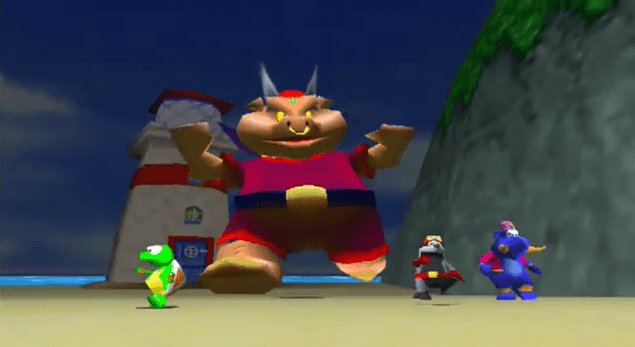
As we begin [editor’s note: end] a new month in the Pixel Mixer community, a new contest is brought upon us. This month, the theme is “Battle Music”. While most people would probably default to an RPG or Fighting game theme, like you’d find in Final Fantasy or Street Fighter, I immediately began to think outside of the box. To me, the music that goes with the final races against Wizpig (from Diddy Kong Racing) should fit the “Battle” theme. However, as Diddy Kong Racing is a kart racing game, most people would not see it that way.
So let’s start with the game itself. How is Diddy Kong Racing (DKR for short) any different gameplay-wise from a game like Mario Kart, F-Zero, or Wave Race? If we look at these games in their most basic form, you can say these are all racing games you can play either by yourself against computers, or go split screen and play against your friends. One thing that makes DKR stand out from these other games is the fact that it has a Story mode to it, rather than just a Grand Prix/Time Trial mode. With this story mode, it plants the seed for the eventual final race, or “battle”, against Wizpig.
But Wait, There’s More
Most racing games have one goal for the player to achieve, and that is to simply win the race. DKR is no exception to this rule, however saying that’s all there is to the game is selling it short. With the story mode, you get introduced to the evil pig-wizard Wizpig. He has taken over the island where the game takes place. This island also happens to be where the main characters of the game hang out and have fun. Your goal for the game is not only to win races, but also to drive (no pun intended) Wizpig out for good.
As you make your way through the game, the courses you play on get progressively more difficult. This allows the player to ready themselves for the few boss fights found in each stage, and also prepares them for the final races against Wizpig.
Something About a Battle
So how do the races against Wizpig differ from any other race? Normally, with most races, when you win, you just get to advance further along in the story by unlocking more tracks. However, with the Wizpig races, there’s actual purpose and incentive to winning the race. If you put yourself into the mind of the game’s characters, your goal is to get rid of Wizpig by any means necessary, which in this case means kart racing. By defeating the evil wizard on his own tracks, you hope that he never returns to mess with the island or it’s inhabitants again. If you lose these races, Wizpig still remains the ruler of the island.
This is where we can start to call these races, “battles”. You must win these races, using all of the skills that you have learned playing through the rest of the game. If you win, you can claim the island back for you and all of the other inhabitants. Once you win the first race, you realize that Wizpig is not done yet, and you must face him one more time, this time with more traps and hazards to try and inhibit you.
As you approach the final race to stop Wizpig, he appears on a rocket which he uses to race against you. You avoid flying rocks, electrical traps, and small caves as you push your way towards first place. If you manage to beat Wizpig, he will be flabbergasted by losing to you. He loses control of his rocket and flies off into space, heading towards a moon. Eventually, he crashes into said moon and the rocket that he rode in on is now demolished, leaving behind a sizeable explosion. Being a Nintendo game, we can’t say that he died in that explosion. However, we can at least come to the conclusion that he has no way of making it back to terrorize the island that you saved.
Well, TECHNICALLY…
So how does that compare to any other games typical battles? When you think of a battle, be it large or small, there is usually a set of conditions that happens: before, during, and after.
Before a battle, you are advancing along a path that you must get through to beat the game. That can be a literal path like you would find in Pokemon or other RPGs, or something like in Street Fighter where your “path” is a set group of people/tasks that you must defeat/complete. In the case of DKR, since the “battle” of that game is Wizpig, your “path” can be considered all of the races and bosses you must complete to get to him.
During the battle is pretty self-explanatory. In most games, that means you are faced in combat with an enemy that you must defeat to progress. Same with DKR, you must defeat Wizpig to progress.
After the battle is usually where you are rewarded. In some cases, you may be awarded with some Experience Points, or some type of currency. Sometimes you’ll unlock new items or areas for you to explore. When it comes to DKR, when you defeat Wizpig, your reward is claiming the independence of the island from his evil that he held over the land.
Final Thoughts
Although it may not be conventional to think of Diddy Kong racing to have a “battle” in it, I believe that you can make a case for this one particular race, even if it is somewhat weak. In fact, I’m sure many of the people reading are probably thinking I put in too much effort just to try and bend the rules my way for this contest. In any case, I will stand by my argument. This is why I believe that Wizpig’s Theme from Diddy Kong Racing should be in consideration for a Battle Theme. It’s not his character theme, and there’s no way to play these tracks outside of the story. It is only when you are battling against Wizpig.
What is a video game battle theme? Do only certain genres of video games have battle themes? Can stage themes or character themes count as battle themes?
The theme for the Pixel Mixers February 2017 Cover Contest is for fan musicians to cover video game music from the ’90s that were used as battle themes. (If you are a musician and would like to participate, click that link for more information about our monthly contests.) But within just a few days of announcing this theme, I received several questions about what counts as a battle theme in a video game.
What are obvious choices for video game battle themes?